
How to Audit Checking Account Fees and Choose a Better Account
Find the fees, friction, and protections that determine what a checking account really costs.
What you will learn
You will learn how to calculate the real annual cost of a checking account, review overdraft settings, compare access and insurance, and move accounts without disrupting deposits or bill payments. The objective is not to chase a promotional bonus. It is to identify an account that reliably handles the way money actually enters and leaves your household.
Start with twelve months of evidence
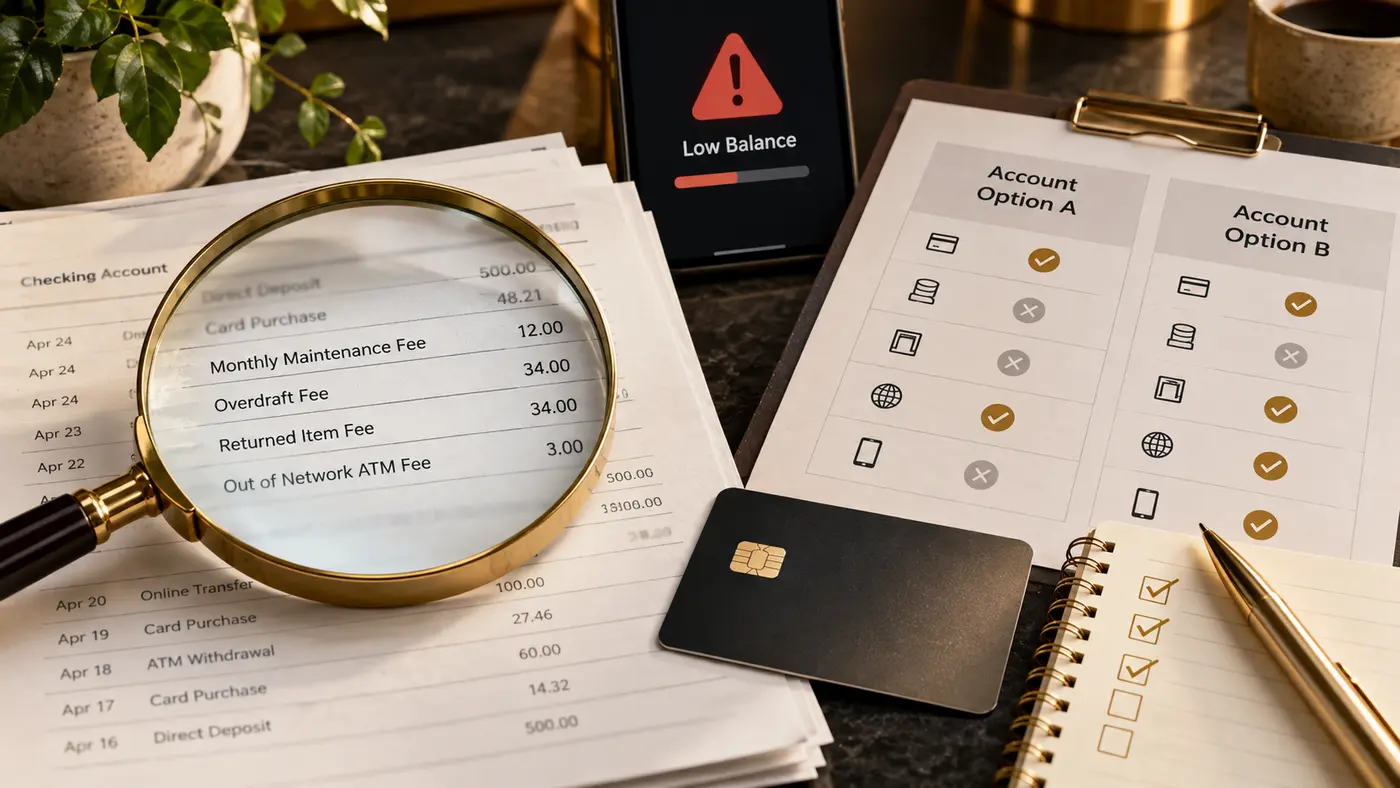
Download a full year of statements and search for every charge that did not purchase a product or service: monthly maintenance, overdraft, nonsufficient-funds, out-of-network ATM, paper statement, wire, cashier’s check, stop-payment, dormant-account, returned-deposit, and foreign-transaction fees. Add them. Then record the conditions that waived a fee, such as a minimum balance or qualifying direct deposit. A $12 monthly fee waived in ten months but charged twice cost $24, not zero. Three $35 overdrafts would add $105. Those are examples; use actual statements and the current fee schedule. Also count indirect friction. If the nearest fee-free ATM requires a costly trip or deposits remain unavailable longer than your cash flow can tolerate, the account has a practical cost even when the fee total is low.
Separate overdraft choices from account balance problems
An overdraft occurs when a transaction exceeds available funds and the institution pays it. A declined transaction is different, and an NSF fee may arise when a check or certain electronic payment is returned unpaid. The CFPB explains that opting out of debit-card and ATM overdraft coverage generally prevents a fee for those declined transactions, but checks and recurring electronic payments can still create fees or other consequences. Review the written setting on the account instead of assuming what was selected years ago. Ask whether overdraft transfer protection draws from savings or a line of credit, what each transfer costs, and whether the linked source can itself create a shortfall. Alerts, a checking buffer, aligned bill dates, and a weekly cash-flow review address the underlying timing problem more directly than relying on repeated fee-based coverage.
Build a one-page comparison
Compare no more than four serious candidates using the same fields: monthly fee and waiver rule; opening deposit; minimum balance; overdraft and NSF policy; ATM network and reimbursements; cash-deposit options; mobile-deposit limits; transfer speed; branch access; customer-service hours; check and wire costs; interest, if any; and deposit insurance. Verify each term in the institution’s current account disclosure, not an advertisement or comparison site. A “free” checking account cannot charge a monthly maintenance fee or require a minimum balance merely to avoid that fee, according to CFPB guidance, but it may still charge for services such as out-of-network ATMs, overdrafts, stopped checks, or printed checks. “Free” therefore does not mean every possible transaction is free.
Confirm deposit insurance and ownership categories
For a bank, verify membership through the FDIC’s BankFind Suite. For a federally insured credit union, use the NCUA’s Credit Union Locator or Share Insurance Estimator. Do not rely only on a logo displayed in an app. Coverage limits depend on the depositor, institution, ownership category, and account structure; balances at the same insured institution can be combined for insurance purposes. A financial-technology interface may place money at one or more partner banks, which can introduce terms about when funds become eligible for pass-through coverage and how records are maintained. Read the deposit agreement and identify the actual insured institution. Deposit insurance protects eligible deposits if an insured institution fails; it does not protect against fraud, investment losses, or every delay in accessing funds.
Test the account against your real cash flow
List pay dates, benefit deposits, rent or mortgage, utilities, debt payments, subscriptions, and the five largest irregular withdrawals. Then simulate a month with tight timing. Suppose $2,200 arrives on Friday, but a $1,450 housing payment, $310 loan payment, and $500 of card and utility drafts post before the next deposit. An account requiring a $1,500 daily balance to waive a fee may be a poor fit even if the average monthly balance appears high. Someone paid in cash needs convenient deposits; a freelancer may care more about incoming ACH timing and transfer limits; a frequent traveler may prioritize ATM access and foreign fees. The best account is the one whose rules match the user’s transaction pattern with reasonable margin for error.
Evaluate service and security before moving
Review how the institution handles a lost card, unauthorized debit, account lock, address change, and beneficiary or payable-on-death designation. Confirm multi-factor authentication, transaction alerts, card controls, and a reliable way to reach support. Read the funds-availability policy, especially for large checks or mobile deposits. Search the institution’s complaint pattern and enforcement history, but distinguish a recurring operational issue from an isolated review. If you use peer-to-peer payments, understand that authorized transfers to the wrong person can be difficult to reverse. Never give a one-time authentication code to a caller. A higher interest rate or bonus does not compensate for an account that is difficult to secure or access during a problem.
Move accounts without creating accidental fees
Open and test the new account before closing the old one. Fund it, activate the debit card, confirm online access, and send a small transfer. Redirect direct deposit and income sources. List every automatic debit from the prior three months plus annual renewals, then move them one by one. Leave enough money in the old account for outstanding checks, pending card transactions, and overlooked drafts. CFPB’s switching checklist recommends waiting until all deposits and payments are operating through the new account before transferring the remaining balance. Download old statements and tax records, obtain written confirmation of closure, and verify that the old account does not reopen because a delayed transaction posts.
Use a measurable decision rule
Score each candidate from zero to two on cost, overdraft controls, access, deposit speed, insurance clarity, service, and security. Weight the categories that matter most. A household that routinely uses cash should not let a slightly better app outweigh difficult deposits. Estimate annual cost under a normal year and a stressful year with two overdrafts, several outside-network withdrawals, or a missed fee waiver. If Account A costs $0 normally but could cost $140 under realistic stress, while Account B costs $36 with stronger controls, the cheaper choice depends on behavior and cash-flow volatility. This scenario is an estimate, not a forecast. The purpose is to expose which assumption controls the decision.
Common mistakes
Do not choose an account solely for a one-time bonus, advertised yield, or familiar brand. Do not close the old account immediately after updating one direct deposit. Do not assume a fintech company itself is an insured bank. Do not keep more cash in checking than the transaction role requires when a separate insured savings account better serves reserves. Avoid opening multiple accounts whose waiver rules and transfer schedules are difficult to manage. Finally, do not treat overdraft fees as the only warning sign. Repeated near-zero balances, late payments, and reversed transfers indicate that the spending system or bill timing needs repair even if the institution happens not to charge a fee.
Key Takeaways
Calculate a full year of actual fees, verify overdraft settings and deposit insurance, and compare accounts using your real transaction pattern. Test the choice under a stressful month, then move deposits and payments gradually. A better checking account reduces avoidable friction, but it cannot replace a workable cash-flow plan.
Sources and Further Reading
CFPB — Bank accounts and servicesCFPB — Know your overdraft optionsCFPB — Moving your checking accountCFPB — What “free checking” can still chargeFDIC — BankFind SuiteNCUA — Credit Union LocatorSources reviewed October 15, 2026. Verify current account disclosures and institution status before opening or moving an account.
 Personal Finance writer
Michael J. Carter
Personal finance writer focused on cash flow, debt reduction, emergency planning, and building durable money habits.
View Michael J. Carter's profileMichael J. Carter is a fictional editorial persona. This AI-generated portrait does not depict a real person. No professional license or credential is claimed.